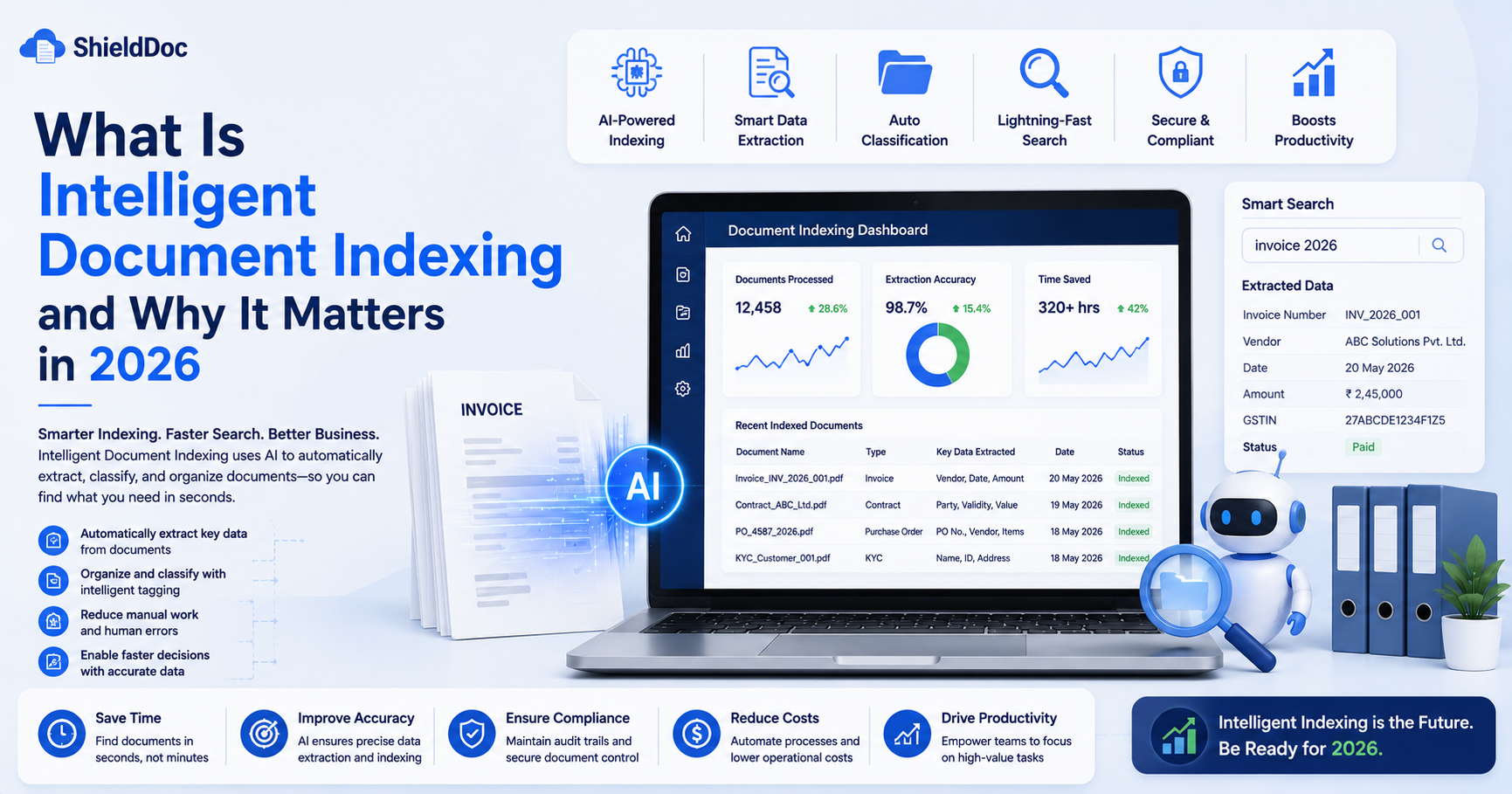
In 2026, businesses are dealing with more documents than ever before, contracts, invoices, emails, HR records, compliance files, customer data, and internal reports. The real challenge is no longer storing information, but actually finding it when needed.
That’s where Intelligent Document Indexing comes in. It is quietly transforming how organizations manage digital information, making search faster, workflows smoother, and compliance easier.
Instead of manually sorting files or relying on basic folder structures, companies are now shifting to Intelligent Document Indexing software that understands content, categorizes it automatically, and retrieves it in seconds.
Let’s break it down in a simple, practical way.
What Is Intelligent Document Indexing?
Intelligent Document Indexing is an advanced method of organizing documents using AI, machine learning, and smart tagging systems. Instead of just storing files in folders, it analyzes the content inside each document and assigns meaningful metadata.
In simple terms, it means your documents are no longer “just stored”; they are understood, labeled, and instantly searchable.
For example:
- A scanned invoice is automatically tagged under “Accounts Payable”.
- A contract is categorized under “Legal Agreements”.
- A resume is indexed under “HR – Recruitment”.
This removes manual effort and reduces the chances of human error.
How Intelligent Document Indexing Works
Behind the scenes, the system follows a structured process:
1. Document Capture
Files are uploaded, scanned, or imported from email systems, cloud storage, or enterprise apps.
2. Content Recognition
OCR (Optical Character Recognition) extracts text from images, PDFs, and scanned documents.
3. Smart Classification
The system applies Smart document categorization based on keywords, context, and document type.
4. Indexing and Tagging
Each document is assigned metadata such as date, department, client name, or project ID.
5. Instant Retrieval
Users can now search using keywords and get precise results in seconds through Instant keyword-based search.
Why Intelligent Document Indexing Matters in 2026
The digital world has become too fast and too complex for traditional document management systems. Businesses that still rely on manual filing systems are already falling behind.
Here’s why it matters more than ever:
1. Explosion of Digital Data
Every company generates thousands of documents daily. Without intelligent indexing, this data becomes noise instead of value.
2. Remote and Hybrid Work Culture
Employees now work from multiple locations. They need secure, cloud-based access to documents anytime, anywhere.
3. Compliance and Data Security
Regulations are stricter in 2026. Companies must ensure Secure and structured file indexing to avoid data breaches and penalties.
4. Speed Defines Productivity
If employees spend time searching for files, productivity drops. Intelligent indexing eliminates that delay.
Key Features of Intelligent Document Indexing Software
Modern Intelligent Document Indexing software is designed to simplify document-heavy workflows. Here are the core features businesses rely on:
Smart Document Categorization
Automatically sorts documents into relevant categories without manual tagging.
Instant Keyword-Based Search
Find any file using simple keywords instead of navigating folders.
Secure and Structured File Indexing
Ensures documents are stored in a well-organized, encrypted structure for compliance and safety.
AI-Powered Metadata Tagging
Extracts and assigns useful data points like names, dates, and references.
Integration with Business Tools
Works with CRM, ERP, cloud storage, and email platforms for seamless workflows.
Benefits of Intelligent Document Indexing
The real value of this system becomes clear when you look at its day-to-day impact on businesses.
1. Faster Document Retrieval
Employees no longer waste time searching through endless folders.
2. Improved Productivity
Teams focus on meaningful work instead of document hunting.
3. Reduced Human Error
Automation minimizes mistakes in file naming and classification.
4. Better Collaboration
Everyone accesses the same structured and updated document system.
5. Stronger Security
Sensitive documents are indexed with controlled access and encryption.
Real-World Example
Imagine a mid-sized finance company handling hundreds of invoices daily.
Without intelligent indexing:
- Staff manually sorts PDFs.
- Files are often misplaced.
- Searching takes several minutes per document.
With Intelligent Document Indexing software:
- Invoices are automatically categorized under vendors.
- GST and invoice numbers are indexed.
- Auditors can retrieve any file in seconds using Instant keyword-based search.
This simple shift saves hours every week.
Common Mistakes Businesses Make
Even with advanced tools available, many companies fail to use indexing effectively.
- Relying only on folder structures: Traditional folders cannot scale with growing data.
- Ignoring metadata quality: Poor tagging leads to inaccurate search results.
- Not training employees: Without proper onboarding, teams don’t fully use indexing capabilities.
- Overcomplicating categories: Too many unnecessary categories can confuse the system.
Best Practices for Effective Document Indexing
To get the best results, businesses should follow a few simple practices:
- Keep categorization simple and logical: Stick to clear structures like Finance, HR, Legal, and Operations.
- Use consistent naming rules: Even with automation, consistency improves accuracy.
- Regularly audit indexed data: Ensure old or duplicate files are cleaned up.
- Enable role-based access: Not every employee needs access to all documents.
The Future of Document Management in 2026 and Beyond
The future is clearly moving toward fully automated document ecosystems. In the coming years, we will see:
- AI predicting document usage before search.
- Voice-based document retrieval.
- Real-time collaboration inside indexed systems.
- Fully automated compliance reporting.
At the center of all this will remain Intelligent Document Indexing, acting as the backbone of digital business operations.
Why Businesses Cannot Ignore This Shift
Companies that continue using outdated systems will face:
- Slower decision-making.
- Higher operational costs.
- Security risks.
- Poor employee efficiency.
On the other hand, businesses using Intelligent Document Indexing software gain a competitive advantage by working faster, smarter, and more securely.
Conclusion
In 2026, managing documents is no longer about storage; it’s about intelligence.
Intelligent Document Indexing transforms messy, unstructured data into a powerful, searchable, and secure knowledge system. With features like Smart document categorization, Instant keyword-based search, and Secure and structured file indexing, businesses can finally take control of their information flow.
It’s not just a technology upgrade; it’s a productivity upgrade.
If your organization still depends on manual document handling, this is the right time to evolve. The sooner you adopt intelligent indexing, the faster your business moves.
Call to Action
Looking to improve document management efficiency in your organization?
Start exploring Intelligent Document Indexing software today and transform how your team stores, searches, and secures information. Smarter indexing means faster decisions, and faster decisions mean better business growth.
FAQs
1. What is Intelligent Document Indexing in simple terms?
It is a system that automatically organizes, labels, and categorizes documents so they can be found quickly using search instead of manual browsing.
2. How does Intelligent Document Indexing software work?
It uses AI and OCR to read documents, extract data, assign tags, and store them in a structured format for easy retrieval.
3. What is Smart document categorization?
It is the automatic grouping of documents into relevant categories based on their content and context without manual sorting.
4. What is Instant keyword-based search used for?
It allows users to quickly find documents by typing keywords instead of remembering file names or locations.
5. Is Secure and structured file indexing important for businesses?
Yes, it ensures sensitive data is protected, well-organized, and accessible only to authorized users, improving compliance and security.