In today’s digital business environment, growth brings complexity. A startup may begin with simple spreadsheets, shared folders, and manual approvals. But as the business expands, document handling becomes harder to manage. Teams increase, processes become layered, approvals slow down, and operational inefficiencies start affecting productivity.
This is where modern enterprise document automation becomes essential.
Businesses today need more than just storage systems. They need intelligent platforms that can automate workflows, improve collaboration, reduce manual work, and scale as operations grow.
That’s exactly where platforms like ShieldDoc make a difference.
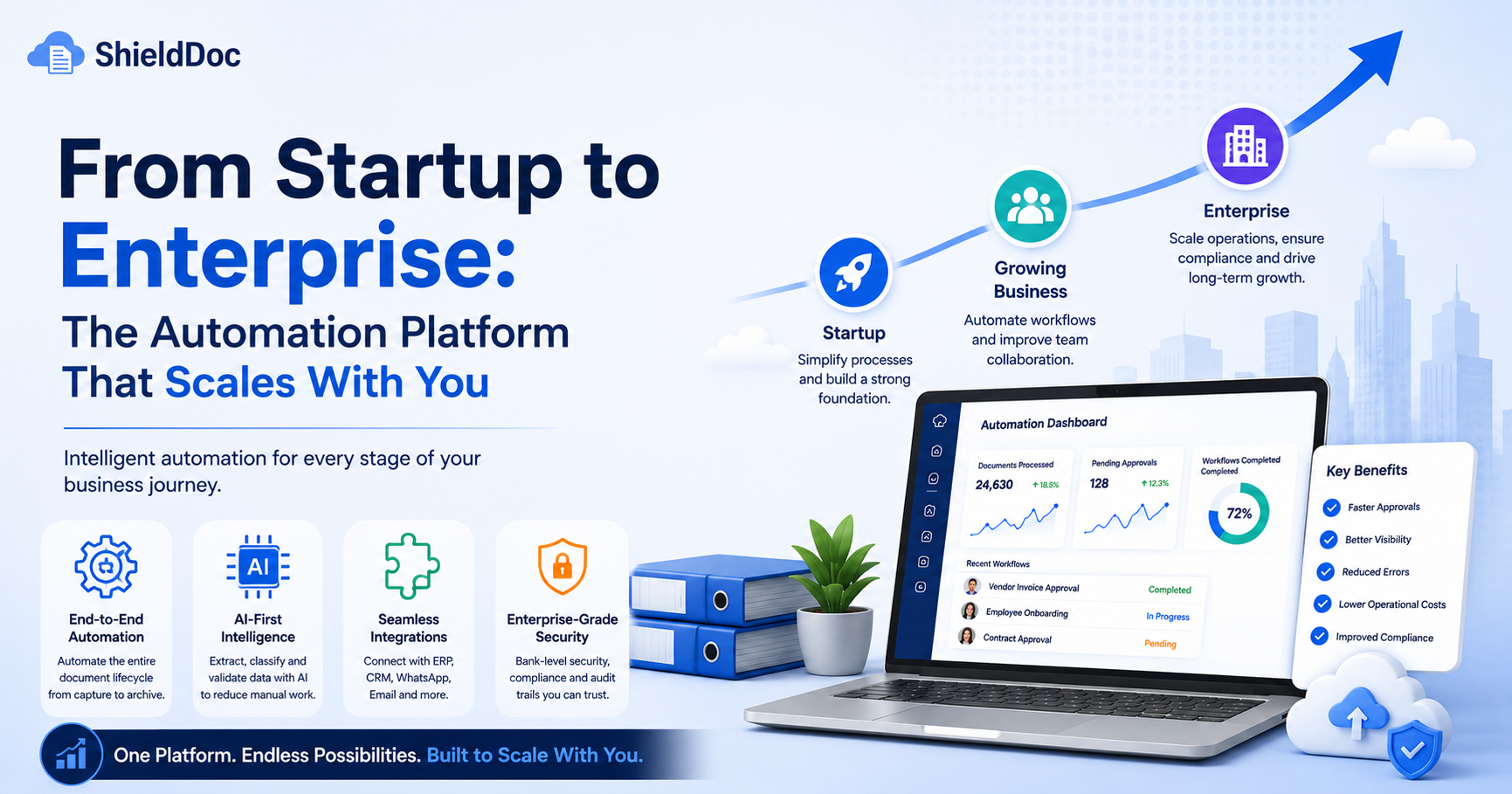
ShieldDoc is built to help organizations move from startup-level operations to enterprise-grade workflow management with scalable automation, AI-driven processing, seamless integrations, and secure document handling.
In this blog, we’ll explore how automation platforms scale with businesses, the real benefits of document automation, and why companies across industries are investing in smarter workflow systems in 2026.
Why Businesses Need Scalable Automation in 2026
Most companies start small.
In the early stage, managing approvals through email or storing files in folders may seem manageable. But as the company grows, manual processes create serious problems:
- Delayed approvals
- Lost documents
- Data entry mistakes
- Poor collaboration
- Lack of workflow visibility
- Compliance risks
- Increased operational costs
This is why modern businesses are adopting workflow automation for documents to simplify operations and prepare for long-term growth.
A scalable platform helps businesses automate processes without constantly changing systems as they expand.
What is Enterprise Document Automation?
Enterprise document automation refers to the use of intelligent software to automate document-related tasks across an organization.
This includes:
- Document capture
- Data extraction
- Approval routing
- File organization
- Notifications
- Archiving
- Workflow tracking
- Integration with ERP and CRM systems
Instead of relying on repetitive manual work, businesses can automate document-centric operations efficiently.
The Automation Platform Built to Scale With You
Modern platforms like ShieldDoc go far beyond basic document storage.
They act as intelligent workflow ecosystems designed for growing organizations.
Here’s how scalable automation platforms support businesses from startup to enterprise level.
1. End-to-End Automation Improves Efficiency
One of the biggest advantages of modern automation systems is complete process automation.
Businesses can automate every stage of the document lifecycle:
- Document capture
- Classification
- Data extraction
- Routing
- Approvals
- Storage and archiving
This reduces manual intervention and improves operational speed significantly.
For example:
A logistics company can automate invoice approvals, vendor documentation, and shipment records without depending on paper-based processes.
This is one of the major document automation benefits for growing organizations.
2. AI-First Intelligence Reduces Manual Work
Modern automation systems use AI to simplify repetitive tasks.
With intelligent document processing, platforms can:
- Automatically extract data
- Classify documents
- Identify missing information
- Detect exceptions
- Improve search and retrieval
This reduces employee workload and improves accuracy.
Instead of spending hours entering invoice data manually, AI can process documents within seconds.
This is why many businesses are investing in cloud-based document automation systems in 2026.
3. Workflow Automation Simplifies Approvals
Approval delays are one of the biggest productivity killers in organizations.
Modern approval workflow software India solutions automate routing and approvals based on predefined rules.
For example:
- HR leave request → Manager → HR department
- Vendor invoice → Finance manager → Accounts team
- Contract approval → Legal → Director → Final archive
Everything moves automatically.
This helps businesses:
- Reduce delays
- Improve accountability
- Eliminate email follow-ups
- Track approval status in real time
The benefits of automated document routing become even more visible as companies scale operations.
4. Real-Time Collaboration Improves Team Productivity
Modern businesses need collaborative document environments.
Teams now work remotely, across branches, and with external stakeholders.
Platforms like ShieldDoc help organizations:
- Collaborate with online document creation, editing, and comments
- Review files in real time
- Track document changes
- Add inline feedback
- Avoid version confusion
This improves communication and speeds up decision-making across departments.
5. Seamless Integrations with Existing Systems
One major challenge businesses face is disconnected software systems.
Modern platforms support:
- CRM integration
- ERP integration
- WhatsApp communication
- Email workflows
- Case management systems
This enables smooth document automation integration with ERP CRM case management systems without disrupting existing operations.
Instead of changing the entire ecosystem, businesses can integrate automation into current workflows.
6. Enterprise-Grade Security Protects Sensitive Data
As businesses grow, data security becomes more important.
Modern automation platforms provide:
- Role-based access control
- Bank-level encryption
- Audit trails
- Compliance management
- Activity tracking
This protects confidential documents while allowing teams to collaborate efficiently.
What Processes Benefit Most from Enterprise Document Automation?
Many organizations ask: What processes benefit most from enterprise document automation?
Here are some of the most common use cases:
Finance
- Invoice approvals
- Expense claims
- Audit documentation
HR
- Employee onboarding
- Leave approvals
- HR records management
Logistics
- Shipment documentation
- Vendor approvals
- Delivery workflows
Healthcare
- Patient records
- Insurance claims
- Compliance documentation
Manufacturing
- Purchase orders
- Vendor contracts
- Inventory records
These workflows become faster, more organized, and more transparent through automation.
How Automation Helps Logistics & Vendor Compliance
Automation is especially useful in industries with complex documentation.
Automation of Document Flow in Logistics
Businesses can automate:
- Shipment approvals
- Delivery records
- Vendor invoices
- Transportation documents
This reduces delays and improves supply chain visibility.
Document Automation Vendor Compliance Benefits
Automation helps companies:
- Track vendor documents
- Verify compliance records
- Manage approvals
- Maintain audit-ready documentation
This reduces operational risk and improves accountability.
How to Automate Document Scanning Workflows
Many businesses still depend heavily on scanned files and paper records.
Modern systems simplify this through intelligent capture systems.
Here’s how businesses automate scanning workflows:
- Scan or upload documents
- AI extracts important data
- Documents are classified automatically
- Workflow routing begins instantly
- Final files are archived securely
This is one of the easiest ways to start document workflow automation without changing entire business operations.
Common Mistakes Businesses Make
Even today, many organizations struggle because they rely on outdated methods.
Common mistakes include:
- Using email for approvals
- Storing files in multiple locations
- Manual data entry
- No centralized workflow visibility
- Lack of integrations
- Ignoring workflow scalability
These issues create inefficiencies that grow worse as businesses expand.
Understanding Document Management System Cost
One of the most common concerns businesses have is pricing.
The truth is, the document management system cost depends on several factors:
- Number of users
- Workflow complexity
- Storage requirements
- Integration needs
- Security features
However, automation usually reduces long-term operational expenses by:
- Saving employee time
- Reducing paperwork
- Minimizing errors
- Improving productivity
That’s why businesses increasingly view document management system pricing as an investment rather than an expense.
Why ShieldDoc is Built for Every Business Stage
Whether you’re a startup, SME, or enterprise, ShieldDoc adapts to your business growth.
Businesses can:
- Automate document workflows in business
- Manage approvals efficiently
- Improve collaboration
- Integrate with existing systems
- Scale operations securely
Its flexible infrastructure makes it suitable for both growing startups and large enterprises managing thousands of documents daily.
Final Thoughts
Business growth should not create operational chaos.
Modern organizations need scalable platforms that simplify workflows, improve collaboration, and automate repetitive tasks efficiently.
From startups managing basic approvals to enterprises handling complex document ecosystems, automation platforms like ShieldDoc help businesses scale smarter.
With features like:
- End-to-end automation
- AI-first intelligence
- Workflow automation
- Real-time collaboration
- Seamless integrations
- Enterprise-grade security
Businesses can modernize operations while improving speed, accuracy, and productivity.
Ready to scale your business with smarter automation?
Explore how ShieldDoc helps organizations automate workflows, improve collaboration, and build enterprise-ready document operations for the future.