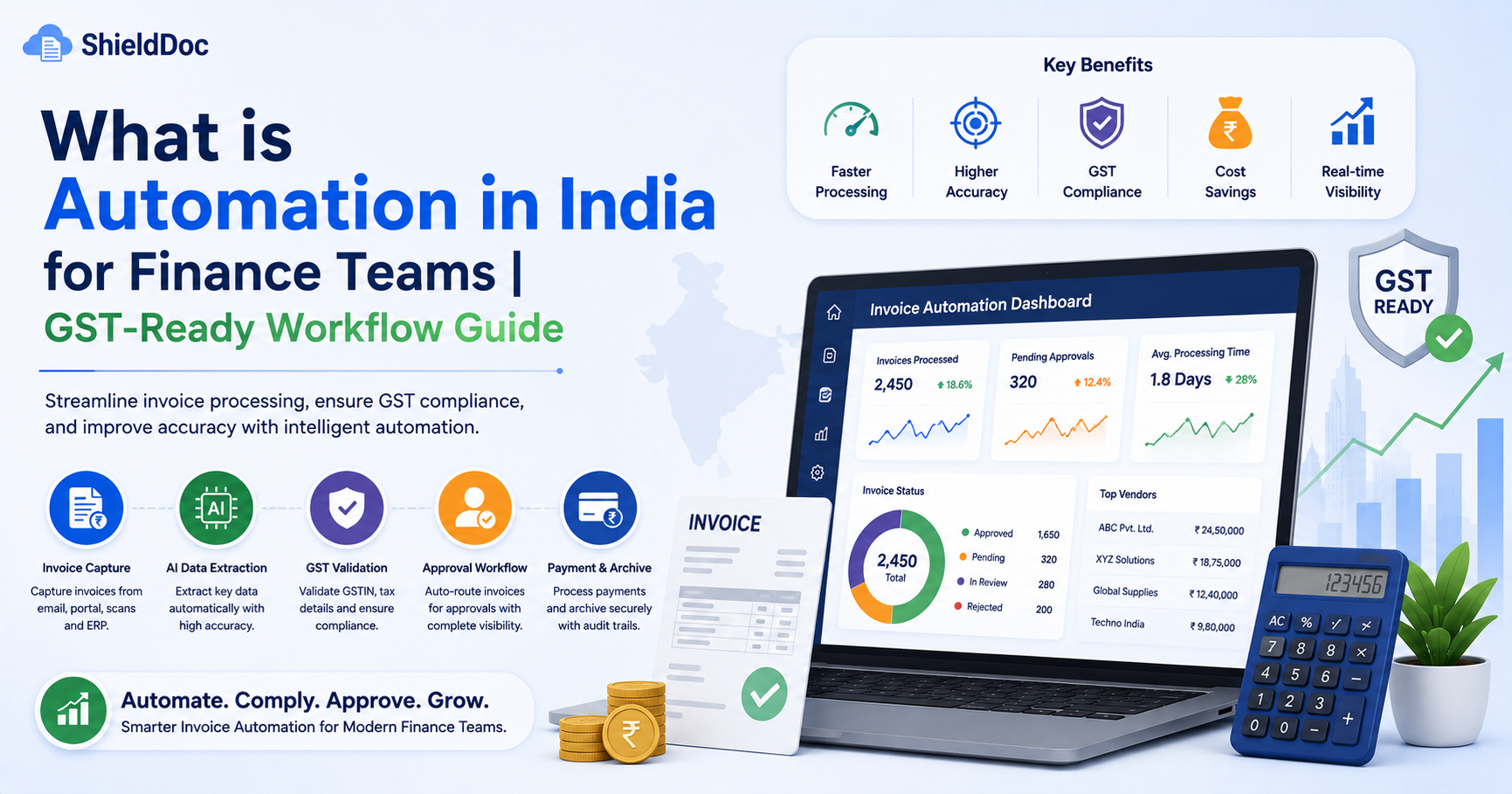
Managing invoices manually has become one of the biggest productivity challenges for finance teams. Every month, businesses process hundreds or even thousands of vendor invoices, GST records, purchase orders, and payment approvals. When these processes rely on spreadsheets, emails, and paper documents, delays and errors become inevitable.
That’s where ShieldDoc comes in.
ShieldDoc is a smart digital automation platform designed to help businesses streamline invoice processing, automate approvals, improve GST compliance, and manage financial documents securely. It is especially useful for organizations looking for a reliable document management and workflow automation solution that improves operational efficiency while reducing manual work.
In this complete guide, we’ll explain how Invoice Automation in India is transforming finance operations, why GST-ready workflows are becoming essential, and how businesses can improve productivity through smarter invoice management.
What is Invoice Automation?
Invoice automation is the process of using software to automate invoice handling from receipt to payment.
Instead of manually entering invoice information, forwarding approval emails, and tracking payments through spreadsheets, businesses can automate the entire workflow.
A modern invoice automation system helps organizations:
- Capture invoices automatically
- Extract invoice data using AI
- Validate GST information
- Route invoices for approvals
- Track payment status
- Store records securely
- Maintain audit-ready documentation
For finance teams managing large invoice volumes, automation significantly improves speed, accuracy, and compliance.
Why Finance Teams Need Invoice Automation in India
As businesses grow, invoice management becomes more complex.
Finance teams often struggle with:
- Manual data entry errors
- Lost invoices
- Delayed approvals
- Duplicate payments
- Vendor disputes
- GST compliance challenges
- Lack of workflow visibility
Invoice automation solves these challenges through intelligent workflows, real-time tracking, and centralized document management.
How Invoice Automation Works
Modern invoice automation platforms follow a structured process designed to reduce manual intervention.
1. Invoice Capture
Invoices can be received through:
- Email attachments
- Vendor portals
- Scanned documents
- ERP integrations
- Mobile uploads
All invoices are collected in a centralized digital environment.
2. AI-Based Data Extraction
The system automatically extracts key information from invoices.
This includes:
- Vendor details
- Invoice numbers
- Invoice amounts
- GST information
- Purchase order references
- Payment due dates
This eliminates repetitive manual data entry and improves processing speed.
3. GST Validation
One of the most important steps for Indian businesses is GST verification.
The system validates:
- GSTIN details
- Tax calculations
- Vendor information
- Invoice compliance requirements
This helps finance teams maintain accurate records and reduce compliance risks.
4. Automated Approval Workflow
Invoices are routed automatically to the correct approvers based on predefined rules.
Examples include:
- Department manager approvals
- Finance team verification
- Senior management approvals
- Procurement validations
This reduces approval delays and improves accountability.
5. Payment Processing & Archiving
After approval, invoices move to payment processing and are archived securely for future audits and compliance checks.
Benefits of Invoice Automation
Organizations implementing invoice automation experience significant improvements across finance operations.
Faster Processing
- Reduce approval turnaround times
- Process more invoices efficiently
- Improve payment cycles
Higher Accuracy
- Reduce manual data entry mistakes
- Improve invoice validation
- Prevent duplicate records
Better GST Compliance
- Validate tax information automatically
- Maintain accurate audit records
- Reduce compliance risks
Improved Visibility
- Track invoice status in real time
- Monitor pending approvals
- Improve financial planning
Cost Savings
- Reduce paperwork
- Lower administrative costs
- Increase team productivity
GST-Ready Workflow Guide for Businesses
GST compliance remains a major responsibility for finance teams in India.
A GST-ready invoice workflow helps businesses ensure that every invoice contains:
- Correct GSTIN details
- Valid vendor information
- Proper tax calculations
- Purchase order references
- Required compliance fields
By automating these checks, businesses can minimize filing errors and simplify audits.
How ShieldDoc Helps Finance Teams
ShieldDoc helps finance departments streamline invoice processing through intelligent automation and workflow management.
Businesses can:
- Automate invoice approvals
- Extract invoice data automatically
- Improve GST compliance
- Track invoice status in real time
- Maintain secure document storage
- Integrate with ERP and accounting systems
This allows finance teams to focus on strategic financial activities instead of repetitive administrative tasks.
Industry Use Cases
Banking Sector
Financial institutions handle large volumes of invoices, contracts, and compliance documents daily.
A modern banking document management system India helps automate approvals while maintaining strict security and compliance requirements.
Insurance Industry
Insurance companies process invoices, policy documents, claims records, and vendor payments regularly.
Insurance document processing automation helps improve operational efficiency and reduce turnaround times.
Manufacturing
Manufacturers can automate procurement invoices, vendor approvals, and purchase order workflows.
Healthcare
Hospitals and healthcare providers can streamline supplier payments and operational expense management.
Common Mistakes Businesses Make
Many organizations still depend on outdated invoice processes.
Common mistakes include:
- Using spreadsheets for invoice tracking
- Manual GST verification
- Email-based approvals
- No centralized document storage
- Poor visibility into workflow status
- Missing audit trails
These challenges often lead to delays, errors, and compliance risks.
Why Businesses Are Adopting Invoice Automation in 2026
Indian businesses are rapidly digitizing operations to improve efficiency and remain competitive.
Modern finance teams need:
- Faster invoice processing
- Better GST compliance
- Real-time visibility
- Automated approvals
- Secure document storage
- Reduced operational costs
Invoice automation helps organizations achieve these goals while improving overall financial control.
Final Thoughts
Invoice processing is no longer just a back-office function. It directly impacts cash flow, compliance, vendor relationships, and business productivity.
Organizations that continue relying on manual invoice handling often face delays, errors, and unnecessary operational costs.
ShieldDoc helps businesses modernize finance operations through intelligent automation, streamlined approvals, GST-ready workflows, and secure document management.
Whether you're a startup, SME, or enterprise, invoice automation can help your finance team process invoices faster, improve accuracy, and build a more efficient financial workflow.
FAQs
1. What is invoice automation?
Invoice automation uses software to automate invoice capture, data extraction, validation, approvals, payments, and document storage.
2. Why is invoice automation important for finance teams?
It reduces manual work, improves accuracy, speeds up approvals, and helps maintain compliance.
3. What is GST invoice automation software?
GST invoice automation software helps businesses validate GST-related information automatically and maintain compliance with Indian tax regulations.
4. Which industries benefit from invoice automation?
Banking, insurance, manufacturing, healthcare, logistics, retail, and enterprises processing large invoice volumes benefit significantly from automation.
5. How does invoice automation improve compliance?
It validates invoice information, maintains audit trails, reduces human errors, and ensures invoices follow predefined compliance rules.