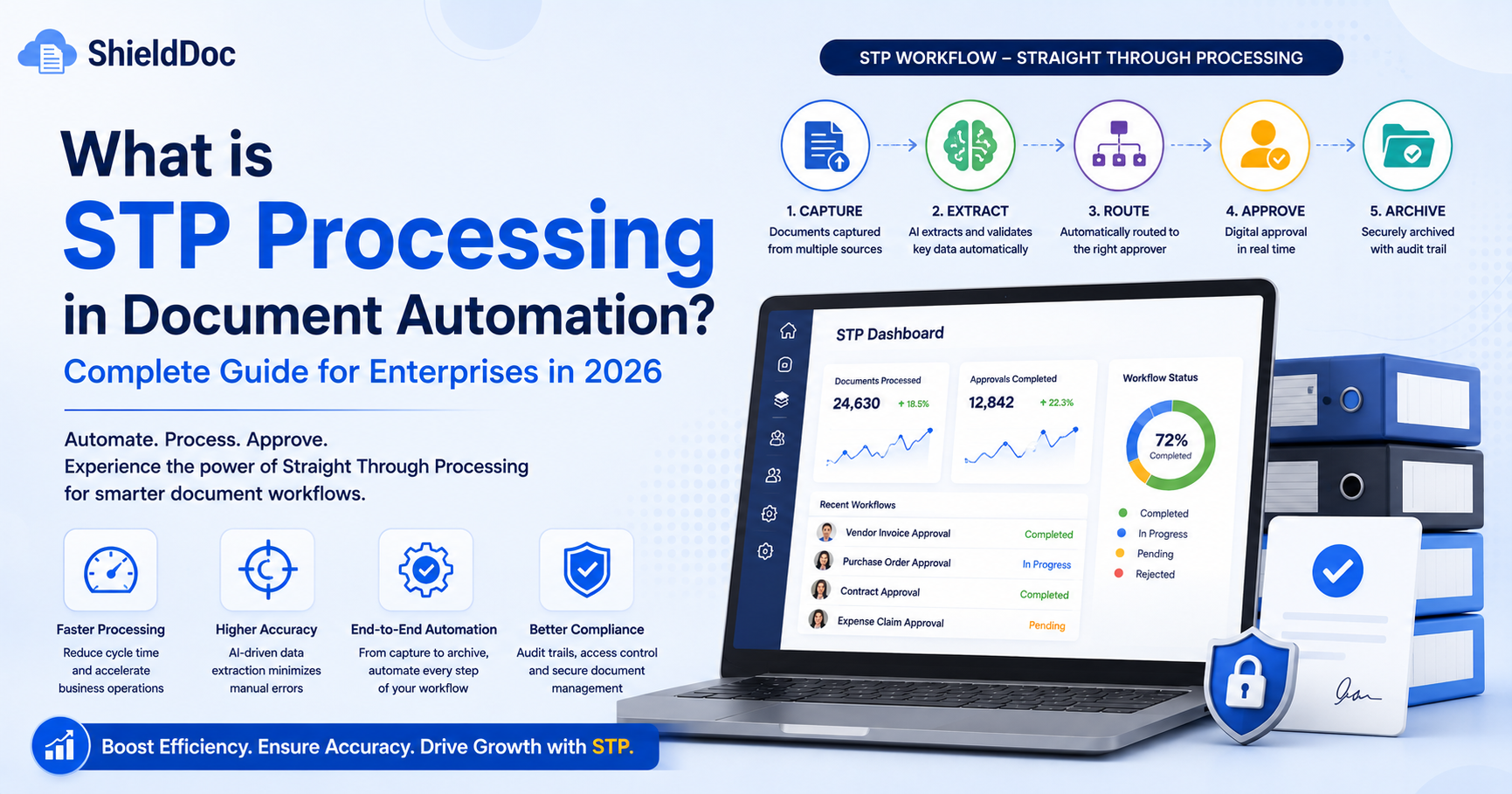
In today’s digital-first business environment, companies are constantly looking for ways to reduce manual work, improve accuracy, and speed up operations. Businesses handle thousands of invoices, contracts, purchase orders, compliance records, HR documents, and approvals every month. Managing these processes manually is slow, expensive, and error-prone.
That’s where ShieldDoc comes in.
Modern organizations are now investing in Document Automation and STP processing to simplify workflows, improve productivity, and reduce operational bottlenecks.
ShieldDoc is a smart digital automation platform designed to help businesses organize files, automate approvals, extract data intelligently, and manage workflows securely. It is especially useful for companies looking for a reliable document management system India that saves time, reduces manual effort, and improves operational efficiency.
In this complete guide, we’ll explain what STP processing is, how it works in document automation, its benefits, industry use cases, and why businesses in India are rapidly adopting enterprise workflow automation in 2026.
What is STP Processing?
STP stands for Straight Through Processing.
In simple words, STP processing means completing a document workflow automatically without manual intervention.
Instead of employees manually checking documents, entering data, forwarding approvals, or updating systems, the automation platform handles the entire process digitally.
For example:
- An invoice arrives via email
- The system automatically extracts invoice details
- The invoice gets routed to the correct approver
- Approval happens digitally
- The system updates ERP or accounting software automatically
- The document gets archived securely
All of this happens with minimal human effort.
This is one of the major benefits of document automation for modern enterprises.
Why STP Processing Matters in 2026
Businesses today cannot afford slow document handling.
Manual operations often create:
- Approval delays
- Data entry mistakes
- Lost documents
- Compliance risks
- Operational inefficiencies
- Higher labor costs
STP processing solves these issues by automating repetitive tasks and improving workflow visibility.
This is why businesses are increasingly investing in enterprise document automation solutions.
How STP Processing Works in Document Automation
Modern enterprise document automation platforms follow a structured workflow for STP processing.
1. Document Capture
The process begins when documents enter the system.
Documents may arrive through:
- Email attachments
- Scanned files
- Mobile uploads
- CRM systems
- ERP platforms
- Vendor portals
2. AI-Based Data Extraction
AI automatically extracts important information from documents.
This may include:
- Invoice numbers
- Customer details
- GST information
- Purchase order values
- Contract dates
- Vendor records
This is why businesses are rapidly adopting AI document automation India solutions.
3. Document Classification
The system identifies the document type automatically.
For example:
- Invoice
- Purchase order
- Contract
- HR application
- Compliance document
4. Workflow Routing
The automation engine routes documents to the correct department or approver.
This helps businesses automate document workflow operations efficiently.
5. Automated Approvals
Approvers receive notifications instantly and can approve documents digitally from anywhere.
This improves speed, accountability, and business productivity.
6. Secure Archiving
After approval, documents are stored securely with audit trails, permissions, and workflow history.
Benefits of STP Processing in Document Automation
Businesses across industries are adopting STP processing because it delivers measurable operational improvements.
1. Faster Processing Speed
One of the biggest document automation benefits is faster processing.
Tasks that previously took hours or days can now be completed within minutes.
2. Reduced Manual Errors
Manual data entry often creates mistakes.
Automation improves accuracy through AI-driven processing.
3. Lower Operational Costs
Businesses save money by reducing paperwork, repetitive tasks, and manual labor.
This is why many organizations compare document management system cost against long-term productivity benefits.
4. Better Workflow Visibility
Managers can track every stage of approvals and workflows in real time.
5. Improved Compliance
Automation platforms maintain audit trails, approval records, and document history.
This helps businesses stay compliant and accountable.
6. Better Customer Experience
Faster document processing improves service delivery and response time.
Industries Using STP Processing in India
Today, STP processing is widely used across multiple industries.
Finance & Banking
- Loan processing
- Invoice approvals
- KYC verification
- Expense management
Healthcare
- Patient records
- Insurance claims
- Compliance management
Manufacturing
- Purchase orders
- Vendor documentation
- Inventory workflows
Logistics
- Shipment approvals
- Delivery documentation
- Vendor invoices
Education
- Student admissions
- Staff approvals
- Digital records
This is why demand for document workflow automation software India is growing rapidly.
Why Businesses in India Need STP Automation
Indian businesses are rapidly digitizing operations.
However, many organizations still struggle with:
- Paper-based approvals
- Email dependency
- Slow document movement
- Scattered files
- Poor collaboration
- No workflow visibility
A modern digital document management system helps businesses eliminate these inefficiencies.
Platforms like ShieldDoc provide:
- Workflow automation
- AI-powered extraction
- Document approval workflow software
- Secure storage
- Real-time tracking
- ERP & CRM integrations
Common Mistakes Businesses Make Without Automation
Many organizations still rely heavily on manual workflows.
This creates several operational challenges.
- Using emails for approvals
- Manual data entry
- No centralized workflow tracking
- Scattered document storage
- Lack of integrations
- Poor compliance management
These inefficiencies become more serious as businesses scale operations.
How to Choose the Right Document Automation Platform
Choosing the right enterprise document automation platform is important for long-term business growth.
Businesses should look for:
- AI-powered automation
- Approval workflow systems
- Cloud access
- Role-based permissions
- ERP & CRM integrations
- Audit trails
- Mobile accessibility
- Scalable infrastructure
Organizations should also compare document workflow automation pricing India based on workflow complexity, integrations, and scalability.
Why ShieldDoc is a Smart Choice in India
Businesses across India are rapidly investing in enterprise automation and digital workflows.
ShieldDoc helps businesses simplify operations through:
- Enterprise document automation
- AI-driven extraction
- Document approval automation enterprise
- Workflow tracking
- Secure document management
- System integrations
Its flexible and scalable platform makes it suitable for startups, SMEs, and large enterprises handling thousands of documents daily.
Final Thoughts
STP processing is no longer a future technology. It has become an essential part of modern business operations.
From invoice approvals to vendor management and compliance workflows, businesses need faster, smarter, and more scalable document processes.
Modern document workflow automation software helps organizations automate operations, improve collaboration, reduce costs, and increase productivity.
Platforms like ShieldDoc are helping enterprises modernize workflows with AI-driven automation, approval routing, workflow tracking, and secure document handling.
If your business still depends on paper files, manual approvals, or disconnected systems, now is the right time to modernize your operations through STP-powered automation.
FAQs
1. What is STP processing in document automation?
STP processing stands for Straight Through Processing, where documents move through workflows automatically with minimal manual intervention.
2. What are the benefits of document automation?
Document automation improves speed, reduces manual errors, lowers operational costs, and increases workflow visibility.
3. Which industries use STP processing?
Finance, healthcare, logistics, manufacturing, education, and enterprises handling large document volumes use STP automation extensively.
4. What is enterprise document automation?
Enterprise document automation uses intelligent systems to automate document handling, approvals, extraction, routing, and storage across organizations.
5. Why is AI document automation important in India?
AI document automation India solutions help businesses reduce paperwork, improve operational efficiency, automate approvals, and manage growing document workflows effectively.